ICGFM Promotes Knowledge Transfer Among Public Financial Management Experts

Working globally with governments, organizations, and individuals, the International Consortium on Governmental Financial Management is dedicated to improving financial management by providing opportunities for professional development and information exchange.

Showing posts with label Basel II. Show all posts

Wednesday, May 19, 2010

XBRL Work Shop at ICGFM Conference

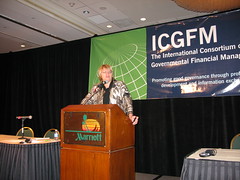
Liv Watson managed an XBRL workshop at the 24th Annual Conference on Public Financial Management. This is a follow-up from her presentation XBRL: The Language of Government 2.0. Attendees to the conference were very interested in the use of XBRL in government. Ms. Watson encouraged attendees to read XBRL documents on-line.

Many countries do not mandate the use of XBRL. XBRL often becomes widely adopted according to Ms. Watson. Regulation sometimes follows adoption.

Global adoption drivers according to Ms. Watson include:
  • Economics to reduce administrative burden, support multiple languages easily
  • Support global standards and pressure from large international organizations
  • IFRS adoption and GAAP alignment
  • Support for capital market transparency
  • Alignment in regulatory consistency
  • Basel II banking supervision
  • Integrate with multiple standards such as ISO, W3C, Swift, OECD
The workshops identified many drivers for XBRL adoption in their countries:
  • Support frequent legislative changes, particularly for changes to reporting standards
  • Legislature or Ministry of Finance may drive adoption
  • Pressure from funding agencies for proper tracking
  • Improved budget planning
  • Support of decentralized reporting such as from municipalities to the central government
  • Improved data collection through standards in areas such as taxation, land registration
  • Integration of tax information with procurement processes
  • Ease of audit through supreme audit institutions
  • Encouragement from international organizations and development partners
  • Improved statistical information for regulators
  • Trade facilitation for regional and global trading organizations
  • Ease of business registration
  • Media and civil society may put pressure on governments
  • Globalization affect where countries that are more transparent will be seen as more stable for business
  • Demands for government transparency
  • Faster closing of government accounts and production of reports

Monday, May 18, 2009

Finanical Sector Strategies for Public Financial Managers: Banking Sector


Paul A. Leonovich is Associate Director for Banking & Financial Services within the
U.S. Department of the Treasury’s Office of Technical Assistance (UST-OTA) discussed worldwide financial crisis and the second order effects that have created the recession.


There were three catalysts for the international financial crisis:


  • Excessive levels of investment capital, as liquidity moved from the stock to housing markets

  • Elevated investor expectations based on the returns of the 1990s

  • Sustained global economic growth that banks thought would continue.


Mr. Leonovich believes that the crisis was primarily caused by failures in risk management. Banks were thought to be safeguarders of investments. Instead, banks sought out more attractive returns and accepted too much risk. Asset prices increased excessively. Many banks did not realize the cyclical nature of real estate prices despite warnings from organizations like the IMF. Banks became over-leveraged at unsustainable rates. Much of this risk was carried off the balance sheet and was thought to not be of concern to banks. However, the reputation of these funds required banks to support these investments.

Companies that made loans were disincented to do so with the appropriate due diligence. Asset deflation in the United States created a vicious downward spiral that including the locking up of credit markets and crisis of confidence among banks.

Mr. Leonovich discussed the need for better regulatory standards. He pointed out the need for international vehicles and the issue of sovereignty. The standards need to be harmonized. He suggested that there needs to be a renewed focus on Basel II. The crisis has helped to better understand risk.

Mr. Leonovich compared credit swaps with a game of "3 card monte". Better capital allocations is going to be important in regulatory standards.

Me Leonovich pointed out best practices to overcome these issues. He hightlighted. approaches to recapitalization by government only after full diagnostic of bank viability and carving out bad assets. He pointed out some approaches like "Good Bank/Bad Bank", and bridging banks so that they can be acquired

Central Banks have an important role to create incentives for investment. The key challenge in easing monetary policies is how to avoide inflation or deflation. Governments require to provide fiscal stimuli, and safety net provisions. Governments and banks need an exit strategy according to Mr. Leonovich.