The International Consortium on Governmental Financial Management (ICGFM) maintains this public financial management blog. The focus is on PFM reform in emerging countries by addressing issues such as transparency, integrated financial management information systems, international donor funding, auditing, cash management, procurement, public private partnerships
ICGFM Promotes Knowledge Transfer Among Public Financial Management Experts
Working globally with governments, organizations, and individuals, the International Consortium on Governmental Financial Management is dedicated to improving financial management by providing opportunities for professional development and information exchange.
Showing posts with label PFM reform "public financial management". Show all posts
Showing posts with label PFM reform "public financial management". Show all posts
Conference c0-chair David Nummy introduced today's theme at the 24th Annual ICGFM Conference. The conference theme is Public Financial Management in the Era of the New Normal - post financial crisis. The focus today will be on the impact of the financial crisis on ongoing PFM reforms. Mr. Nummy observed that PFM reforms have been accelerated because of the financial crisis. Government realize that improving governance, efficiency and effectiveness is necessary because of reduced government revenues.
50% of attendees believe that transparency and accountability is the most important reform initiative during this era of the "new normal".
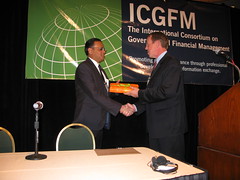
Rakesh Verma received an award for the longest trip to ICGFM at 34 hours.
This review of literature on experience with Public Financial Management Reform was commissioned by DFID on behalf of the Dutch Ministry of Foreign Affairs, the Swedish International Development Cooperation Agency (Sida), the Canadian International Development Agency (CIDA) and the African Development Bank (AfDB). It aims to synthesise the main theoretical approaches and findings from evaluations of PFM reform programmes, and to identify knowledge gaps. The literature reviewed includes academic and technical articles, development practitioner guides, manuals, handbooks and websites.
The review seeks to address two sets of information: an overview of models and approaches, and a review of reform experience. It did not prove possible to relate reform experience to the models presented, which represents a significant shortcoming in our understanding of PFM reform. In reality, the links between theoretical and practical approaches are weak – in the case of the newer approaches, reform experience has pre-dated the models, and indeed informed their development. The evaluations reviewed here did not make use of theoretical models to inform their evaluation frameworks. It would therefore contribute to the PFM evaluation literature if the forthcoming evaluation was to base its design framework explicitly on recent theoretical models, and our understanding of the institutional basis of each model. PFM Lit Review Final
Public financial management reform should be a holistic exercise according to Bill Dorotinsky of the IMF. Speaking at the June “DC Forum” of the International Consortium on Government Financial Management (ICGFM) in Washington DC, Mr. Dorotinsky discussed trends and fads in Public Financial Management (PFM).
The ICGFM focuses on knowledge transfer to government financial professionals in developing nations. Mr. Dorotinsky presented statistics about themes in donor advice and funding to developing nations, suggesting that “one size does not fit all”. In particular, the approach to decentralization, accrual accounting, budget management and financial management information systems need to be tailored to the country context. The “big bang” approach often does not work. Sequenced reform is often more effective. Mr. Dorotinsky pointed out that it is unrealistic to expect rapid modernization in developing nations. Many developed nations have not achieved effective government performance management or fiscal transparency.
Sharing good practices and facilitating dialog among practitioners of PFM enables all countries to benefit. Mr. Dorotinsky is a strong advocate of knowledge transfer through many forums and the IMF blog on Public Financial Management.
Jim Brumby of the World Bank says that PEFA has been mainstreamed at the World Bank. PEFA (Public Expenditure and Financial Expenditure) also provides an opportunity for dialog among countries and with donors. Mr. Brumby also asserted that public financial management is the "core of the core" for governance at the World Bank.
Countries like to compare with other countries and see the rate of progress over time. This leverages the objective comparitive information available through PEFA. PEFA also provides discipline in the World Bank to improve internal processes.
Mr. Brumby (standing)said that the country needs to be "in the driver's seat" for PEFA to be effective.
Case studies from Mali, Malawi and Columbia were presented by husitha D. Pilapitiya of Casals & Associates (left). Dr. Miguel Angel Moralesrussi Russi, the Controller of Bogota Colombia, (near right) andJohn Sitton of Emerging Markets Group, (far right). Reference was made to the presentation from the previous day. (Located at http://icgfm.blogspot.com/2008/05/introduction-to-pefa-framework-to.html)
Mr. Brumby says that the HR indicators from the PEFA model are being piloted at the World Bank.
Dr. Arpád Kovács, President of the Hungarian State Audit Office, said that the new members of the European Union faced the similar and complex problems in financial management at the ICGFM conference. These includes problems in the lack of credible budgets and transparency. Growing globalization has drawn governments to modernize in order to support economic growth. This helps to converge economic development with public finances.
Ivor Beasley of the World Bank says that legislatures need to effectively monitor the government to improve accountability. The legislative systems differ among countries, according to Mr. Beasley. Strong public accounts, audit and budget committees are needed to improve public financial management.
The case of Ghana was described by Marilyn Aniwa, the In-Country Coordinator of the Parliamentary Center and two Members of Parliament, the Honorable Paul Collins Appiah-Ofori and the Honorable Samuel Sallas-Mensah. The introduction of live public meetings in 2007 has shown the people of Ghana that the the government can be held accountable by the legislature.

 Conference c0-chair David Nummy introduced today's theme at the 24th Annual ICGFM Conference. The conference theme is Public Financial Management in the Era of the New Normal - post financial crisis. The focus today will be on the impact of the financial crisis on ongoing PFM reforms. Mr. Nummy observed that PFM reforms have been accelerated because of the financial crisis. Government realize that improving governance, efficiency and effectiveness is necessary because of reduced government revenues.


 Posts
Posts


