
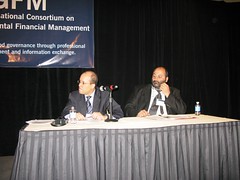
 Dr. Craig Reed, Senior VP at DynCorp introduced the panel looking at the use of civil society and other non-governmental independent mechanisms to provide oversight for development. He introduced the panel:
- Gema Aragones, Deputy Chief of Party on the USAID/MCC Threshold Anti-corruption Project for Paraguay
- Eduardo Flores, Deputy Chief of Party on USAID’s Mobilizing Action Against Corruption Project in Armenia
- Varazdat Karapetyan, President, Chamber of Commerce and Industry, Gegharkunik Province, Armenia
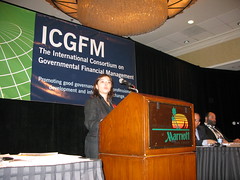 the MCC Threshold program in Paraguay. The project targets government areas that have the highest changes of corruption. She described how internal, audit and external controls are being strengthened in 12 public institutions in Paraguay. Ms. Aragones said that information and communications systems provide accountability reports to the public. Citizen participation and oversight is encouraged through these reports and the devolution of government services. She described the process of citizen oversight of local health councils and the need for political will.
The Government of Pa
 raguay has developed an Office of Support for Citizen Control with the assistance of Casals and Associates. Access to information is essential to promote integrity. The office also manages citizen complaints. Ms. Aragones said that there has been significant improvements in transparency over the past 2 years but that more civil society organizations need to be involved in Paraguay.
Gema Aragones,ICGFM Accountability English
Gema Aragones,ICGFM Accountability Espanol
Gema Aragones,ICGFM Accountability Francais
Eduardo Flores described transparency initiatives in Armenia. Mr. Flores asked what organizations are responsible for transparency. He described the need for political will, independent media, professional audit, independent legislature, effective law enforcement and other civil society actors. He suggests that not all accountability pillars need to be strong in order to achieve positive anti-corruption. NGOs are used as advocacy and assistance centers in Armenia to manage anti-corruption activities. 11 regional centers have been established. He provided statistics showing 863 corruption cases resulting, so far, in 87 under prosecution. Institutional inefficiencies have also been identified. Armenia anti-corruption processes are gaining improved government credibility according to Mr. Flores.
Mr. Flores had some interesting observations on how citizens change behaviour depending on where they are.
EduardoFloresTrejo ICGFM Social Control Mechanisms Armenia.english
EduardoFloresTrejo ICGFM Social Control Mechanisms Armenia Espanol
EduardoFloresTrejo ICGFM Social Control Mechanisms Armenia-Francais
Varazdat Karapetyan, President, Chamber of Commerce and Industry, Gegharkunik Province in Armenia provided specific anti-corruption cases. He described the systemic analysis of the case of where a doctor demanded payment for free services. Mr. Karapetyan pointed out that underpaying doctors creates corruption. He described how holistic analysis provides a roadmap for reform. He emphasized that the culture from the former Soviet times needs reform.
Mr. Karapetyan described how systemic extortion by tax and the registry of new business government ministries was addressed. He also described how individual instances of corruption were adjusted.
VarazdatKarapetyan ICGFM Transparency English
VarazdatKarapetyan ICGFM Transparency Francais
VarazdatKarapetyan ICGFM Transparency Espanol


 Posts
Posts


