
Showing posts with label risk management. Show all posts
Showing posts with label risk management. Show all posts
Friday, December 13, 2013


Monday, December 6, 2010
Addressing Current Governance and Risk Management Challenges in Governmental and
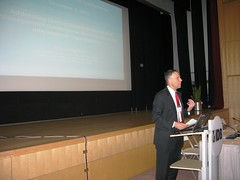
Alan N. Siegfried, Auditor General of the Inter-American Development Bank presented "Addressing Current Governance and Risk Management Challenges in Governmental and
International Organizations" at the ICGFM Winter Conference. The IaDB has been a prime mover in public financial management reform in Latin America and the Caribbean. He described the changes in the organization to improve the performance of the organization.
On a lighter note, Mr. Siegfried described the wonders of risk management thanks to George Costanza from the Seinfeld television series.
Mr. Siegfried described the current global economic challenges that generate uncertainty and unpredictability including turmoil in financial markets, changing regulatory environment and budget restrictions. Mr. Siegfried believes that this uncertainty presents the internal audit profession with an opportunity to demonstrate leadership in risk management, control and governance. He cautioned that internal audit is crucial to improve the credibility of governance structures. He warned the attendees that internal audit is often seen as inflexible and non-responsive to emerging risk. And, many organizations have cut disproportionately in oversight because of reduced budgets.
Mr. Siegfried described the important role of internal audit to help management identify risks, design risk management strategies, and monitor the effectiveness of control. He pointed He described lessons learned. Mr. Siegfried emphasized the differences between risk management, control and governance. He recommended that organizations must take some risk, otherwise the organization become stagnant.
Mr. Siegfried suggested that organizations must balance risk and opportunity. Risk management is about risk mitigation, not about eliminating risk. He described governance structures and the principles for enterprise risk management. He recommended more holistic views on risk management. He pointed out that Standard & Poors is now using enterprise risk management as part of organizational valuation.
Mr. Siegfried presented an overview of risk management for international organizations. He suggested that risk management does not need to be a centralized function. Accountability is critical regardless of whether centralized or decentralized risk management models are used.
He showed the roles that internal audit should take, could take and should not take in risk management. He spoke about risk velocity where problems can happen very quickly, like the earthquake in Haiti.
There is a significant value proposition to internal audit. Internal audit needs to move from recognized to trusted to valued. Mr. Siegfried provided an overview of the risk management evaluation framework. He provided a list of financial, compliance, strategic and operational risks to consider.
Mr. Siegfried concluded by suggesting that risks facing organizations are unprecedented and stakeholders’ expectations continue to increase. He recommended that individual practitioners and organizations must ‘raise the bar’ to most effectively represent and advocate for strong governance and risk management. Organizations need to move from hindsight to insight to foresight.
Siegfried addressing current governance and risk management challenges in governmental and international organizations
View more presentations from icgfmconference.
Siegfried relever les défis de la gouvernance et de la gestion de risques actuels dans les organisations gouvernementales et internationales
View more presentations from icgfmconference.
Monday, May 17, 2010
Internal Controls and Risk Management
Internal controls can reduce corruption, according to Mario Andrade, the Auditor General, Office of the Attorney General of Ecuador. Mr. Andrade says that transparency does not come by accident, it comes through processes.
Mr. Andrade agrees that it is better to practice integral risk management when there is sufficient information. However, risk can be managed without full information.
No country can achieve objectives without an internal control structure. Governments can only encourage citizen participation through publishing of information according to Mr. Andrade. Information that is not published has no value. Audit is an important part of the internal control structure. Mr. Andrade provided a full discussion of an internal control and risk management structure.
The control environment requires ethics, integrity and senior leadership. This supports accountability. Mr. Andrade provided a detailed list of actions necessary to create a control and risk management environment. He emphasized the need for goals and indicators. The higher the objective, the higher the risk.
Mr. Andrade said that accountability and transparency requires processes. It is very difficult to ensure accountability without proper processes. These processes must follow each step from the data being available until it is disseminated. Human Resource processes are also required for internal control according to Mr. Andrade. This helps set the environment for internal controls. Each step must have accountability, according to Mr. Andrade. The processes must be defined. The way in which public servants are accountable must be defined.
Training and capacity building is critical to effective internal controls, according to Mr. Andrade.
Information Technology can enable more effective transparency. Mr. Andrade warns that the IT system needs to be properly designed and there needs to be a strategic plan. The system must be fully integrated.
Transparency requires simple information publishing such as government budgets and budgets by results, according to Mr. Andrade. This information is accessible to the public and adds social control to government and accountability.
Mr. Andrade recommends that auditors become active in promoting internal controls. Modern audit requires active participation to improve integral risk management. Risk management also means that there is a reasonable chance of achieving goals and risk is mitigated. Mr. Andrade introduced a risk map to show where resources should be focused. Organizations should begin articulating and managing risk even before detailed statistics are available. Mr. Andrade showed a risk management audit plan in a matrix format.
Mr. Andrade ended his presentation by observing that people do not like controls. But, proving the results of controls can achieve acceptance.
Evaluating Sovereign Risk: Debt and Capital Markets
Tom Briggs of USAID introduced the subject of sovereign risk by pointed out that the world financial sector in 2007 showed that public sector debt represented about 1/2 the private sector debt in Developing Countries. The formula is almost the opposite in Emerging Markets. Mr.Briggs expects to see private debt expanding faster than public debt in Emerging Markets. Growth cannot occur until sovereign debt is better handled, according to Mr. Briggs. Mr. Briggs introduced the methods for underwriting sovereign debt.
Mr. Briggs introduced Mark Stumpf, Senior Partner, Arnold & Porter, LLP. Mark Stumpf concentrates his practice in international financial transactions in the public and private sectors. He advises foreign governments and public sector entities on financing, debt restructuring, and related transactions. He described how there can be multiple government borrowers in a country creating confusion.
Mr. Briggs also introduced Derrill Allatt, Managing Partner, of NewstatePartners, LLP. Mr. Allatt described how to determine a sustainable level of sovereign debt. Countries with a good history of paying back debt are often able to achieve better rates despite high debt to GDP ratio. Many European countries have high debt rollover ratios. The financial crisis has contributed to fiscal deficits through emergency spending such as bank takeovers with the reduction of tax revenue. Many countries suffer from trade deficits and exchange rate changes.
Mr. Allatt described the contagion effect. This occurred in the past through economies that were not always integrated. The herd effect is one of the possible contributors to financial crisis contagion. Many Emerging Country sovereign debt is now considered less risky than some countries in the European Union. He provided a Case Study on Belize and a discussion on Greece.
There was some discussion about the situation in Greece. Panelists agreed that the lack of transparency in Greece with misleading information increased the financial crisis. Panelists also agreed that the rating agencies need more independence in order to provide accurate information. Mr. Briggs suggests that the Internet had eliminated part of the revenue model turning rating agencies into profit centers.
Tom Briggs Sovereign Debt Espanol
Mr. Briggs introduced Mark Stumpf, Senior Partner, Arnold & Porter, LLP. Mark Stumpf concentrates his practice in international financial transactions in the public and private sectors. He advises foreign governments and public sector entities on financing, debt restructuring, and related transactions. He described how there can be multiple government borrowers in a country creating confusion.
Mr. Briggs also introduced Derrill Allatt, Managing Partner, of NewstatePartners, LLP. Mr. Allatt described how to determine a sustainable level of sovereign debt. Countries with a good history of paying back debt are often able to achieve better rates despite high debt to GDP ratio. Many European countries have high debt rollover ratios. The financial crisis has contributed to fiscal deficits through emergency spending such as bank takeovers with the reduction of tax revenue. Many countries suffer from trade deficits and exchange rate changes.
Mr. Allatt described the contagion effect. This occurred in the past through economies that were not always integrated. The herd effect is one of the possible contributors to financial crisis contagion. Many Emerging Country sovereign debt is now considered less risky than some countries in the European Union. He provided a Case Study on Belize and a discussion on Greece.
There was some discussion about the situation in Greece. Panelists agreed that the lack of transparency in Greece with misleading information increased the financial crisis. Panelists also agreed that the rating agencies need more independence in order to provide accurate information. Mr. Briggs suggests that the Internet had eliminated part of the revenue model turning rating agencies into profit centers.
Tom briggs sovereign debt
View more presentations from icgfmconference.
Derrill allatt sovereign debt
View more presentations from icgfmconference.
Mark stumpf sovereign debt
View more presentations from icgfmconference.
Tom Briggs Sovereign Debt Espanol
Wednesday, June 3, 2009
Managing Risk in Post Conflict Aid Projects

Dr. Arthur Keyes, President and CEO of International Relief and Development (IRD), described how to mitigate risk in aid projects at the June DC Forum in Washington. Dr. Keyes highlighted his presentation by describing the need for accountability within his organization. He remarked that he spends more time with auidtors than with his own children.
Dr. Keyes provided pointers on mitigating risk in conflict and post-conflict countries including:
- Providing security personnel
- Operating "under the radar" so as not to be obvious
- Work with the community for programs
- Ensure that donor commitments are in writing
- Hire local staff and manage with ex-patriots
- Build local capacity
- Ensure proper rotation of ex-patriots to reduce burn-out
- Find methods to ensure that projects are being accomplished - with pictures
- Audit to ensure that funds were disbursed properly
Optimizing aid delivery is a topical subject. Dr. Keyes answered questions about the transition to civilian government in Afghanistan and Iraq. He noted that we have all seen the world change in front of our eyes. He remarked that he recently spent a week in Baghdad and Mosul but did not hear any explosions.
Dr. Keyes explained his journey to creating IRD during the Balkan crisis. Since founding in 1990, IRD has grown from 3 people to around 4,000. IRD is the largest NGO recipient of USAID and operates in 35 countries serving 100 million people with an annual budget of about $500 million.
Sunday, May 24, 2009
Announcement: DC Forum, June 3 - Managing Risk When Operating in Conflict and Post-conflict Environments
Managing Risk When Operating in Conflict and Post-conflict Environments
Fascinating insight into the risks, challenges, and accountability issues associated with providing relief and development programs in conflict and post-conflict areas around the world
The June 3 DC Forum, sponsored by Mosley and Associates, to be held at the Carnegie Endowment will provide fascinating insight into the risks, challenges, and accountability issues associated with providing relief and development programs in conflict and post-conflict areas around the world

Dr. Arthur B. Keys, Jr., President and CEO of International Relief and Development will speak about operating in regions of the world that present social, political, and technical challenges, IRD particularly specializes in helping communities going through and coming out of conflict and war to recover and improve.
Sponsored by Mosley and Associates

Subscribe to:
Posts (Atom)


 Posts


