
Government Performance Management must move beyond the Budget
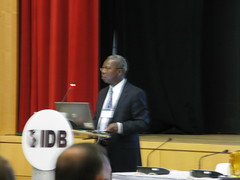
Jean-Baptiste Sawadogo, the President of Leader One, provided an overview of Managing for Results (MfR) in Public Financial Management (PFM). MfR is about strategy.
Jean-Baptiste Sawadogo of Leader One described the importance of Management for Results (MfR) on Government Performance Management. He pointed out that finance is not everything when improving results in government. He provided a history of management for results in government. He described performance innovation and adoption of results-focused PFM and the use of performance audits
Performance audits and the use of civil society in improving results were introduced by J-B Sawadogo. Performance budgeting is not necessarily results-based because they can focus on allocating money rather than performance. He suggested that budget is a tool in private sector flexibility but is rigid in the public sector.
Jean-Baptiste Sawadogo is seeing the the harmonization of language and concepts. Public finance experts realize that indicators are for measurements and that activities are not results.
MfR is still focused on a Public Expenditures Management mentality. Mr. Sawadogo described how the budget process has supremacy n most countries. Countries are trying whole-of-government approaches but there remains a strong agency/sector/functional orientation rather than a true ‘Results for Citizens’ focus.
Mr. Sawadogo suggests that MfR in developing countries focuses on public expenditure management and anti-corruption. The main emphasis in developed countries is a by-product of austerity and crisis management He described the dilemma of stimulus packages – trying to get quick results yet fear of risks.
The model of performance management in China is very interesting. China is creating rigorous MfR programs according to Mr. Sawadogo.
Problems that need to be overcome include:
Mr. Sawadogo showed how MfR can be used in PFM:
Mr. Sawadogo suggests that ‘Managing for Results’ in government is here to stay - citizens will keep pushing for results. Public financial managers can please auditors - but have a duty to please citizens.
Jean-Baptiste Sawadogo, the President of Leader One, provided an overview of Managing for Results (MfR) in Public Financial Management (PFM). MfR is about strategy.
Jean-Baptiste Sawadogo of Leader One described the importance of Management for Results (MfR) on Government Performance Management. He pointed out that finance is not everything when improving results in government. He provided a history of management for results in government. He described performance innovation and adoption of results-focused PFM and the use of performance audits
Performance audits and the use of civil society in improving results were introduced by J-B Sawadogo. Performance budgeting is not necessarily results-based because they can focus on allocating money rather than performance. He suggested that budget is a tool in private sector flexibility but is rigid in the public sector.
Jean-Baptiste Sawadogo is seeing the the harmonization of language and concepts. Public finance experts realize that indicators are for measurements and that activities are not results.
MfR is still focused on a Public Expenditures Management mentality. Mr. Sawadogo described how the budget process has supremacy n most countries. Countries are trying whole-of-government approaches but there remains a strong agency/sector/functional orientation rather than a true ‘Results for Citizens’ focus.
Mr. Sawadogo suggests that MfR in developing countries focuses on public expenditure management and anti-corruption. The main emphasis in developed countries is a by-product of austerity and crisis management He described the dilemma of stimulus packages – trying to get quick results yet fear of risks.
The model of performance management in China is very interesting. China is creating rigorous MfR programs according to Mr. Sawadogo.
Problems that need to be overcome include:
- Expenditure mentality
- Supremacy of the budget
- Risk adverse culture
- Complexity in government/self preserving structures
- Divided governance: Political; Legislative; Public Service; Judiciary; Decentralized regimes…
- Short-to-medium term electoral cycle vision
- Increased discourse but still confusion and insufficient practice
- Difficulty in moving beyond activities and outputs
Mr. Sawadogo showed how MfR can be used in PFM:
- Strong MfR leadership at the top
- Long term orderly MfR implementation (culture change takes time)
- Long-term results-focused country vision
- Comprehensive country results framework
- Results-focused country strategic documents
- Results-friendly risk-mitigation practices
Mr. Sawadogo suggests that ‘Managing for Results’ in government is here to stay - citizens will keep pushing for results. Public financial managers can please auditors - but have a duty to please citizens.
3.30 4.15pm Managing For Results In Pfm (Jean Baptiste Sawadogo)
View more presentations from icgfmconference.
3.30 4.15pm Managing For Results In Pfm (Sawadogo) French
View more presentations from icgfmconference.


 Posts
Posts


