ICGFM Promotes Knowledge Transfer Among Public Financial Management Experts

Working globally with governments, organizations, and individuals, the International Consortium on Governmental Financial Management is dedicated to improving financial management by providing opportunities for professional development and information exchange.

Showing posts with label cash management. Show all posts

Friday, May 21, 2010

Value of Treasury Single Accounts in Government


Sailendra Pattanayak, Senior Economist, Fiscal Affairs Department, the International Monetary Fund, discussed Treasury Single Accounts (TSA). He suggests that the TSA aids cash management and facilitates other functions in public financial management. He presented diagrams showing the typical payment system with many bank accounts and the use of a TSA.
Mr. Pattanayak pointed out the TSA handles payments from all spending units separately. Unlike the use multiple bank accounts, the cash balances roll up to a single account.
The TSA is not just a single bank account. It can be multiple accounts rolled up to a single accounts. Mr. Pattanayak pointed said that the TSA is a unified structure of government bank accounts that gives a consolidated view of government cash resources. It could be just one account or a set of linked accounts (main and subsidiary). He warned that as far as possible, all public entities should be consolidated to the TSA. The TSA should be legally recognized, institutionally robust and stable according to Mr. Pattanayak.

Mr. Pattanayak agreed with previous presentations on cash management in that cash controls should be de-linked from budget controls. He emphasized that the TSA can contain ledger sub-accounts for control and monitoring purposes, but these should not contain over-night balances. He said that options for accessing the TSA is mainly dependent upon institutional structures and payment settlement systems. The cash balance in the TSA is maintained at a level sufficient to meet daily operational requirements of the government according to Mr. Pattanayak.

The TSA is nothing new according to Mr. Pattanayak. He warned that revenue and expenditure transactions should be classified through a well-developed chart of accounts and not by maintaining distinctive bank accounts for them. He recommends that the TSA should be maintained in the national currency because budget execution is in the national currency.

The benefits of the TSA includes:
  • Ensures complete, real-time information on government cash resources
  • Helps preparation of accurate and reliable cash flow forecasts
  • Optimizes the cost of government operations
  • Facilitates efficient payment mechanisms
  • Improves operational and appropriation control during budget execution
  • Enhances efficiency and timeliness of bank reconciliation
  • Facilitates timely and more complete accounting statements/reports
Mr. Pattanayak described the TSA structure when there are limited and advanced Treasury communications and information systems, and through integration with the banking industry. He introduced the requirements for an efficient TSA:
  • Co-operation of the line ministries
  • Development of an Interbank settlement/clearing system
  • Real Time Gross Settlement System (RTGS) at the central bank for high value transactions
  • Major commercial banks and treasury connected to the RTGS
  • Development of a small payments clearing system
Mr. Pattanayak described different banking arrangements and the management of payments, receipts and balances. He said that individual cash books are not needed when using the TSA.

Mr. Pattanayak described the coverage of the TSA. The minimum is to manage the entire central government. Public corporations are generally not included in the TSA. He described the possible integration of social security and other trust funds.

Mr. Pattanayak described how the TSA could include both central and sub-national governments. He also described the integration of transaction processing with government accounting systems. He warned that centralized payment systems can lead to inefficiencies and high transaction costs without IFMIS automation and accounting controls.

Many donors are concerns about putting funds into the TSA:
  • Assurance for use of donor aid on specific projects (or non-diversion of funds)
  • Some ring-fencing to avoid liquidity problems (and ensure timely payments during project execution)
  • Minimize exposure to exchange related fluctuations/losses in the value of donor aid (when currency exchange rate regime is volatile)
  • Reliability of controls (in managing donors’ funds) and information produced by the national PFM systems
These donor issues can be addressed by activities such as the separation of currency sub accounts according to Mr. Pattanayak

Mr. Pattanayak described some of the issues that need to considered when designing a TSA. He described country-specific issues. He recommended that the design of the TSA should form part of the design of an Integrated Financial Management Information System (IFMIS). He described the preconditions for establishing the TSA including political support, regulatory requirements and the need for technological integration. He emphasized the need to formalize banking agreements. The Chart of Accounts may need to be extended to cover non bank expenditure transactions. He pointed out that moving to a TSA will require some capacity development among users.


Thursday, May 20, 2010

Cash Management: Managing Cash Inflows and Outflows

Mike Ablowich of the US Department of the Treasury, Office of Technical Assistance, discussed the managing of cash inflows and Outflows at the 24th Annual ICGFM Conference in Miami Florida. The presentation formed part of the workshop on government cash management.

Mr. Ablowich pointed out that there are accounting and banking controls than can be used. Better control over inflows and outflows enables better cash management.

Accounting controls includes allotments and appropriations. Additional accounting controls include:
  • Payment frequency
  • On-demand vs. once per week disbursements
  • Vendor analysis
  • Aggregation of multiple payments to single vendors
  • Payment terms
Banking products that are leveraged in the United States are available in other countries:
  • Mobile phone banking
  • Zero balance account to eliminate idle balances
  • Fraud prevention
  • Wire transfers
  • Automated Clearing House
  • Disbursements
  • Purchasing and T/E Cards
  • Deposits - Paper Checks and reducing fraud through issue file, positive pay & payee name verification
  • Armored car/currency
  • Lock box
  • Credit cards
Mr. Ablowich suggests that developing country governments can advocate these products to banks. The result can be that the private sector in these countries can also make use of the efficiencies associated with these products.

Mr. Ablowich described the advantage of issuing purchasing cards. Purchasing cards reduce controls. Nevertheless, there are numerous advantages for purchasing cards including:
  • Simplifies purchasing and payment process
  • Responding quickly to disaster problems
  • Provide controls by type of expenditure
  • Lower overall transaction processing costs per purchase
  • Increased information for analysis
  • Reduced paperwork
  • Set/control purchasing limits
  • Simplify end of year tax reporting
Bank reconciliation is a critical part of cash management according to Mr. Ablowich. He advocates daily reconciliation because of the lag between payments and cash balance.

Cash Forecasting from Cash Management Workshop

Mike Ablowich of the US Department of the Treasury, Office of Technical Assistance, discussed government cash forecasting at the 24th Annual ICGFM Conference. Cash forecasting can be used as the basis for evaluating strategic financial policy objectives. He described the entire budget planning and execution lifecycle. He emphasized the importance of cash flow forecasting during budget execution.

Cash flow planning and forecasting synchronizes revenue estimates and spending plans according to Mr. Ablowich. The budget is built in law. But, the budget is different from the authority to spend. This results in a need for a coordinated effort to make sure that resources are available when needed to properly execute the budget and meet the needs of a variety of budget stakeholders. Mr. Ablowich pointed out that cash flow forecasting may or may not be done in conjunction with the process of preparing allotments and apportionments. He pointed out that if a strong system is in place to control spending rates then some cash flow forecasting functions presented are not entirely applicable.

Financial & Treasury Control includes comparing actual cash flows to estimates including asset and liability management to shorten "float." Mr. Ablowich said that preparing cash flow estimates will lead to improvements in the collections and disbursement processes and reduce the cost of funds. He advocates Net Present Value (NPV) analysis even though not all NPV concepts are applicable to the public sector.

Mr. Ablowich addressed liquidity management. He pointed out that liquidity management requires forecasting the cash position to manage maturities and issuance of investments and debt. In other words, "Do I have the right amount of cash when I need it?"

Cash Flow Forecasting Process

The cash flow forecasting process includes selecting forecasting horizons: short term (less than 1 month), medium term (quarterly) and long term (1 year or more). Mr. Ablowich cautions that the longer the forecast horizon, less accurate the forecast. He suggests that it does not make sense to spend time doing a daily forecast for a year from now.

Mr. Ablowich recommended coordinating many participants in cash forecasting such as spending units, central banks, macro-economic planning, treasury and budget.

It is important to remember that the Treasury, according to Mr. Ablowich, in the initial stage of the preparation of a cash flow statement, has to act as an impartial assembler of information to coordinate the preparation of a cash flow forecast. For that reason the forecast must tie back to the budget, otherwise other agencies or stakeholders will believe that the treasury is trying to alter or make judgments about the budget that has already been passed by the legislature. He pointed out that budgets are typically provided on a cash basis, so this should flow nicely into the cash forecast.

Mr. Ablowich recommends using the 80 - 20 rule. He said that this is the most important slide in his presentation to remember. 80% of revenue comes from 20% of the sources. VAT and customs taxes typically represent the 80% of government revenues. Some countries generate significant revenue from resources. Therefore, more time needs to be spent on sources that generate 80% of the revenue.

Cash Forecasting Methodologies

Mr. Ablowich described different cash forecasting methodologies. He described forecasting on afund or agency basis. The choice has to be rational and be supported by the cost/benefit of different planning, collection and forecasting techniques. If a strong I.T. system exists for compiling and synchronizing spending plans then the agency approach might make the most sense according to Mr. Ablowich. If there are three or four major fund groups of equal size then it may make sense to approach this on a fund basis.

Mr. Ablowich described forecasting on an economic or functional basis. Using the economic classification likely lends itself to the easiest forecast to compile and analyze. The functional approach is likely not needed if realistic plans are prepared by agencies on an economic classification basis.

Mr. Ablowich warned that there will always be different degrees of certainty about cash flows. Less predictable cash flow should be considered in risk management, according to Mr. Ablowich. He suggests that payroll represents a certainty for payment. But, large payments on construction projects are less certain.

The types of information sources were discussed by Mr. Ablowich. Integrated Financial Management Information Systems are a data source. The information sources need to be analyzed: cash vs. accrual accounting, treasury single account vs. multiple bank accounts, and methods of budget execution.

Cash Flow Forecasting and Budget Management

Mr. Ablowich discussed revenue forecasting. Budgets should be the source reference. A bad budget will lead to a bad cash flow forecast especially if the revenue estimates are poor from the beginning. The initial budget revenue estimate must be backed by some consistent, corroborating macroeconomic analysis.Weekly or daily estimates of the monthly plan can be prepared using historical daily data lined up against “payment due dates”. Some payments are affected by seasons.

Expenditures can be analyzed based on spending plans and historical trends according to Mr. Ablowich. The past is usually the best predictor of the future in countries with mature financial and budgetary systems. The past can be the best predictor of the future in countries with young financial and budgetary systems if information can be “normalized” for the current year’s situation. He pointed out that governments must be able to predict payroll and pensions payments. He also pointed out looking at the calendar for patterns. For example, standard payments of one source may be made every Friday. Some months have 5 Fridays.

Mr. Ablowich discussed the impact of assets and liabilities on cash forecasting. He introduced how other balance sheet accounts need to be examined for forecasting. He showed spreadsheets from Zambia and Madagascar as examples. He suggested that long-term forecasts require larger teams from throughout the government.

Cash Forecast Variances

There are numerous factors that can be responsible for variances between forecasts and actuals according to Mr. Ablowich. These include:
  • Economic growth higher or lower relative to assumptions
  • Economic conditions leading to increased borrowing costs or higher investment earnings
  • Inflation rates higher than expected leading to higher rates of growth in indexed payments.
  • Disasters/Emergency Situations
  • Foreign Exchange
Mr. Ablowich pointed out that legal issues can affect cash flow variances including:
  • Changes to tax laws by legislature that effect revenue collections.
  • Payouts of settlements of court cases.
  • Court interpretations of existing tax laws or spending mandates.
  • Sharing ratio of taxes between levels of government.
Understanding and Measuring "Float"

Details about understanding and measuring "float" was presented by Mr. Ablowich. He provided clear definitions:

Collection Float
  • Mail Float: the delay between the time a check (payment) is mailed and it is received.
  • Processing Float: The delay between the time a payment is received and it is deposited.
  • Availability Float: The delay between the time a payment is deposited and the time the account is credited.
Disbursements Float
  • Mail Float: The delay between the time a check is mailed and the date the check is received.
  • Processing Float: The delay between the time the payee receives the check and the time the check is deposited.
  • Clearing Float: The delay between the time the check is deposited and the time it is presented to the payor’s bank for payment.
Mr. Ablowich described float analysis in cash management. The purpose of analyzing disbursement and collections float is to shorter this float to as few days as possible. Decreased costs will come in the form of higher interest earnings, avoidance of interest costs and fewer errors in processing. Decreasing process time should also lead to improved internal efficiencies and improved customer service according to Mr. Ablowich. Cutting down the time for funds to go from point A to point B and having information systems tracking this information every step of the way will lead to decreased costs. Shortening disbursement or collections float will likely be the result of using improved banking products or making changes in internal administrative processes.

Float is measured as:

Average Daily Float = Total Dollar Days of Float/Total Calendar Days in Period

Annual Cost of Float = Average Daily Float * Opportunity Cost of Funds

Cash Management Workshop Debt and Investment Policies

Laura Ross from the US Treasury, Office of Technical Assistance described debt and investment policies for proper government debt management. She described how many policy documents are obsolete. Policy documents must not be static.

Ms. Ross explained the importance of tying debt issuances to forecasts. This includes planning matching of service dates to cash forecasts. She described the type of debt vehicles like bonds and notes. She recommended that debt policies should include:
  • Issuance Guidelines
  • Allowable Investments for Proceeds
  • Statements on Projects
  • Refinancing
  • Glossary of terms
Ms. Ross described the need to also tie investments to forecasts. She recommended benchmarking investments to determine investment priorities. Investments should be secure. She recommended:
  • Follow the code of your state or country, then be conservative
  • Be very specific in your investment policy on what can and cannot be used (examples on the next few pages)
  • Investment policy needs to have oversight
  • Constantly monitor information
  • Monitor investment report daily
  • Should be selected by a committee
  • Should understand how the investment works
  • Diversify the investment portfolio
Ms. Ross talked about internal and external investment risk. Risk can be mitigated. She described an investment policy should include:
  1. Objective – typically safety, liquidity, yield.
  2. Roles – who is responsible for investing the funds (ultimately)
  3. Investment Monitor
  4. Finance Board
  5. Ethics and Conflict of Interest
  6. Internal Controls
  7. Uses for Investment Proceeds
  8. Benchmarks
  9. Purchasing Investments – Mechanics
  10. Allowable Investments
  11. Report Components
  12. Glossary of terms
Ms. Ross explained the importance of determining how investment revenue should be used. She warned that investment revenue should not be used to reduce taxes. She showed an example of portfolio management.

She recommended the following links for information on debt and investment policies:

Debt Policy Links - Links
Municipal Bond Terms - LinksInvestment Policy - Links

Banking Relations

Laura Ross from the US Department of the Treasury, Office of Technical Assistance, discussed the development of Requests for Proposals for banking services. She warned that RFPs should only be issued when it is needed. There are proper times to create RFPs. You do not need an RFP to ask banks for new proposals on new services.

Step 1 – Document the current environment

The purpose of this step is to understand the current environment for banking services, the key business and technical requirements and identify potential service gaps and improvement opportunities, according to Ms. Ross. This step includes:
  • Banking Needs Assessment
  • Prepare a customized packet for each area of your treasury organization regarding their current banking services
  • Request current bank account analyses for all banks and accounts
  • Design a checklist determining necessary information to gather from each function
Step 2 – Develop the RFP

Developing the RFP takes the longest time according to Ms. Ross. Ms. Ross has been on both sides of the banking RFP process. She warns that many RFPs are too large, often include the same question asked five times. The RFP provides a conceptual design of the future banking structure. This step requires:
  • Develop an overall vision for banking structure and services required
  • Analyze current bank account structures and providers
  • Inventory and assess specific concerns and issues for bank service requirements
  • Determine list of banks to be included in RFP process
  • Develop the customized RFP for those selected banks and issue RFP
Step 3 - RFP Evaluation

Ms. Ross said that the third step focuses on evaluating and prioritizing the bank responses to determine which banks can realistically be considered to move from the current to the target environment. The purpose is to objectively prioritize banks based on their capabilities and responses and to recommended banks identified to participate in bank presentations and visits. She recommends a pre-bid conference. All questions received should be officially answered in writing and provided to all bidders. The evaluation process includes:
  • Customize RFP evaluation tool for bank services
  • Conduct quantitative analysis of RFP responses
  • Score bank RFP results on a weighted basis
  • Perform additional technical and qualitative analysis on bank RFPs
  • Complete cost analysis on proposed pricing using the estimated volumes
  • Determine the short list of banks to participate in the presentation phase
Ms. Ross recommends developing a check list, best on a single page, that ranks the responses. There should be a ranking method. Cost analysis is the most important aspect. She warned that many government RFPs do not provide accurate numbers to enable proper pricing.

Step 4 - Finalist Presentations and On-Site Tours

The fourth step is the research and validation to ensure that the bank can meet the current and future requirements, as stated in their response, at a level of satisfaction to your needs. This step validates the response with the real requirements. Ms. Ross provided explained the process:
  • Notify the banks that did not make the final cut
  • Contact the short list of banks that made the final cut to let them know of next steps and give them advance notice
  • Develop the desired presentation format/script, and provide this to the banks
  • Schedule the presentations and bank visits
  • Evaluate the demonstrations formally and debrief after each meeting
  • Conduct on-site tours of finalist banks as necessary
Ms. Ross suggests getting a list of bank references. She recommends starting at the bottom of the list because the bank will not have time to brief all references.

Step 5 - Bank Selection and Plan Development

The fifth step is the selection of the bank and development of an overall plan which will consider the key tasks, the staffing / skill requirements, timeframes and estimated costs required as next steps to move towards the targeted environment. The process includes selecting the preferred bank(s). Ms. Ross stressd that the implementation plan is the critical step. The result is a documented implementation plan for the conceptual design of the preferred banking structure. She recommends a signed contract.

Cash Management Workshop: Organization and Communication

Gail Ostler of the US Treasury, Office of Technical Assistance, recommended how cash management should be organized in governments. She described the responsibilities of the cash management unit:
  • Forecasts, monitors and tracks cash flows
  • Prepares cash flow reports and identifies and reports on variances
  • Provides leadership and direction to all ministries / departments on cash management issues
  • Develops and maintains cash management policies and procedures
  • Recommends improvements in all aspects of cash management to strengthen internal controls and enhance available cash balances
  • Prepares risk and cost benefit analysis
  • Maintains banking relationships
Ms. Ostler pointed out that leadership is the most critical responsibility for cash management units. She suggested that many government cash management units do not proactively recommend improvements. She described the qualifications needed to be an effective cash manager. The ability to communicate is critical to be effective, according to Ms. Ostler.

A slide showing the flow of information needed in cash management was presented by Ms. Ostler. It is important to know when there will be large pieces of revenue coming to the government. Information sources include:

  • Banking System (Commercial and / or Central Bank)
  • Accounting System
  • Budget Spending Quotas, Plans and Amendments
  • Reports Monitoring Budget Execution
  • Macro-Economic Forecasts
  • Major Budget Institutions (Exception Reporting)
  • Revenue Institutions (Exception Reporting)
  • Debt Unit
Ms. Ostler stressed that information from big spending units is critical to cash management. She described the use and purpose of cash management committees.

What is Government Cash Management

Gail Ostler of the US Treasury says the financial crisis has created a significant awareness of the cash management. She believes that many PFM experts have a narrow view of cash management. Cash management is much more than cash flow forecasting or Treasury Single Accounts. Ms. Ostler defines cash management as "having the right money in the right place at the right time to meet government objectives."

Cash Management Objectives

Ms. Oslter said that the objectives of cash management include cash mobilization, controlled disbursements, investing money and reduce borrowing. Other objectives include:
  • Safeguard cash and investment
  • Minimize the volume of idle balances
  • Match the timing of cash inflows and cash outflows
  • Reduce operational risk
  • Pay vendors on time because late payments increases the cost of goods and services.
  • Reduce the cost of borrowing
  • Minimize transactions costs
  • Increase investment income
What Cash Management Is Not

Ms. Ostler pointed out that cash management is not a substitute for poor budgeting decision. It is not a substitute for spending in excess of budget authority or any form of budget and accounting controls. Many governments have incorrectly managed budgets through cash management according to Ms. Ostler. Many governments use Ministry bank accounts to attempt to control budgets. The result is that the government loses cash control. Ms. Ostler advocates that cash management must be delinked from budget controls.

Results of a Poorly Defined Program

Ms. Ostler articulated the problems associated with poorly defined programs, particularly those resulting from the proliferation of both private and central bank accounts. Other poor results include:
  • Restrictions of the use of cash often results in unnecessary borrowing or lost investment income
  • Impossible to reconcile all accounts
  • Treasury isolated from cash information
  • Thwart central bank monetary policy
  • Cash rationing that prevents proper budget execution
  • Overly expensive bank changes
Components of a Strong Program

Ms. Ostler defined the components of a strong program including:
  • Written policies and procedures
  • Strong cash management organization
  • Bank relationships
  • Reduction of bank accounts
  • Collections made through the banking system
  • Deposit accounts swept daily to central government accounts
  • Treasury performs centralized payments
  • As many payments as possible should be electronic
  • Cash disbursements eliminated or minimized
  • Ministries and agencies penalized for making commitments outside of their budget authority
  • Full cash flow forecasting, on a 12 month roll-forward basis
  • Follow-up on variances between cash flow forecasts and actual payments
Ms. Ostler advocates strong banking relationships where the government is managing the relationship with banks. She pointed out that many governments do not use spending plans effectively. The surprises in disbursements relate to large infrastructure and capital projects. It is difficult for Ministries to stick to spending plans. She advocates the use of exception reporting. Governments can look at these large projects and find ways to match expenditure with revenue patterns.

Many cash managers analyze information in their offices according to Ms. Ostler. She advocates being proactive and understanding where there are cash is coming from. Ms. Ostler advocates that governments should look at the banking relationships in other countries.

Ms. Ostler responded to a question about deficits. She says that managing cash when there is not cash means looking at systemic issues. Governments need to reduce expenditure budgets when there are revenue shortfalls.

Procurement linkage with commitments is needed for effective cash management according to Ms. Ostler. Many long-term projects have multiple year commitments. She advocates linking with government commitment accounting systems.

Ms. Ostler said that there are ways to allow ministries to manage projects that are tied to revenues the ministry has collected without giving them cash control and separate bank accounts.

Government Cash Management Workshop

The financial crisis has increased the burden for governments to manage liquidity, cash and debt. The public financial management (PFM) workshops at the 24th. Annual International Consortium on Governmental Financial Management (ICGFM) Conference began with a full day session on cash management. The intense training was provided by financial experts from the United States Department of the Treasury.

The majority of participants at ICGFM conferences come from developing countries. The US Department of the Treasury is very active in international technical assistance to governments around the world. The workshop was led by four members of the US Treasury Technical assistance who have significant international experience:
  • Laura Trimble, Associate Director, Budget and Financial Accountability, US Department of the Treasury
  • Michael Ablowich, Budget and Financial Accountability, US Department of the Treasury
  • Gail Ostler, Budget and Financial Accountability, US Department of the Treasury
  • Laura Ross, Budget and Financial Accountability, US Department of the Treasury
The workshop was opened by Laura Trimble who described the services provided by the group. She pointed out that US Treasury is the equivalent of the Ministry of Finance in other countries.

Agenda for Government Cash Management training:

Session 1: Gail Ostler: What is Cash Management
  • Definitions & Objectives
  • What Cash Management Is Not
  • Results of a Poorly Defined Program
  • Components of a Strong Program

Session 2: Gail Ostler: Organization and Communication
  • Establishing Cash Management Unit
  • Flow of Information
  • Policy Committee

Session 3: Gail Ostler & Laura Ross: Treasury Single Account & Banking Relationships

  • Definition of a TSA
  • Challenges and Steps to Moving toward Centralized Accounts
  • Central Bank Versus Commercial Banks
  • Learning About the Banking Environment
  • Examples of RFPs for Banking Services

Session 4: Laura Ross: Debt and Investment Policies
  • Tying Debt Issuances to Forecasts
  • Short-term Versus Long-Term Debt
  • Assumption of Investment Risk
  • Ensuring Investments Are Secure
  • Examples of US State and Local Government Investment Policies

Session 5: Mike Ablowich: Cash Flow Forecasting
  • Objectives
  • Process of Cash Flow Forecasting
  • Components of the Forecast
  • Analysis of Variances
  • Understanding and Measuring Float

Session 6: Mike Ablowich: Managing Cash Inflows and Outflows

  • Objectives
  • Techniques

Laura Trimble: Wrap-up
  • Q&A
  • Evaluations


Public Financial Managments Workshops Open at 24th Annual ICGFM Conference

ICGFM Conference Co-Chair, David Nummy, opened the Public Financial Management workshop sessions of the 24th Annual Conference. He discussed the importance of cash management in government. The ICGFM conference participants were asked about the effects of the financial crisis on government. The survey results included:

  • 88% of participants say that the financial crisis has affected public financial management reform in their countries
  • 39% say that the financial crisis has had a positive effect on PFM reform
  • 52% of participants say that the biggest effect of the financial crisis has been in revenue collection
  • over 80% believe that the effects of the financial crisis on PFM reform is not permanent

Wednesday, May 19, 2010

Transparency and Accountability Most Important PFM Reform

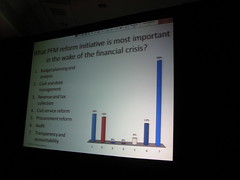
50% of attendees at the 24th Annual ICGFM Conference agreed that transparency and accountability improvement is the most important government reform necessary after the financial crisis.

ICGFM, the International Consortium on Governmental Financial Management, attracts members from around the world. The Public Financial Management (PFM) experts at the conference in Miami Florida come from over 35 countries.

ICGFM uses audience voting to ask questions about PFM reform. The top votes for the most important reform initiative in wake of the financial crisis was:

  • Transparency and accountability 50%
  • Budget planning and analysis 18%
  • Cash and debt management 16%
  • Audit 13%
  • Procurement reform 8%

Wednesday, March 17, 2010

ICGFM 24° Conferencia Internacional en Miami

ICGFM se complace en anunciarles los resultados del llamado para oradores/ panelistas/ ponencias para la 24° Conferencia Internacional en Miami, del 16 al 21 de mayo. A través de este proceso se han seleccionado cuatro sesiones de la conferencia. Las mismas incluyen:

  • Sr. Aleksey Lavrov, Jefe del Departamento de Política Presupuestaria y Metodología, Ministerio de Asuntos Financieros y la Sra. Anna Busarova, del Centro de Investigación Presupuestaria, RusiaGestión de gastos en un nuevo ambiente económico - [Expenditure Management in a New Economic Environment]
  • Sr. Mario Andrade, Auditor General, Oficina del Ministro de Justicia, EcuadorControles internos y riesgos de la administración – [Internal Controls and Risk Management]
  • Sr. Rakesh Verma, Director Contable General, IndiaEl rol cada vez más amplio y las responsabilidades cada vez mayores de los auditores públicos – [The Expanding Role and Increasing Responsibility of Public Auditors]
  • Sra. Maria Betania Xavier, Jefa del Departamento de IT, Secretariado del Tesoro Nacional, BrasilNuevas técnicas para aumentar la transparencia las finanzas públicas [New Techniques to Increase Transparency in Financial Management]

También se confirmó para nuestros días especiales de capacitación una sesión completa sobre Gestión de fondos en efectivo, presentada por el Departamento del Tesoro de los Estados Unidos.

Otras sesiones confirmadas sobre el tema de la conferencia de Gestión financiera pública en la era del “nuevo normal” se anunciarán próximamente.

¡Resta menos de un mes para asegurarse los descuentos por inscripción anticipada!

Los precios son los siguientes:

Réservation à l’avance si la totalité est payée le 7 avril 2010 ou avant

Réservation normale, si la totalité est payée le 5 mai 2010 ou avant

Réservation sur place à partir du 6 mai 2010 et jusqu’au début de la conférence

# DaysMember Non-MemberMemberNon-MemberMemberNon-Member

Paquete Completo de la Conferencia

5USD 960.00USD1,010.00USD1,060.00USD1,110.00USD1,160.00USD1,210.00
Días de Conferencia General3USD 760.00USD 810.00USD 860.00USD 910.00USD 960.00USD1,010.00
Días de Capacitación Especial2USD 460.00USD 510.00USD 560.00USD 610.00USD 660.00USD 710.00

Se encuentran disponibles las siguientes formas de pago:

- Tarjeta de crédito – se aceptan todas las tarjetas de crédito importantes
- Online vía PayPal con su tarjeta de crédito o información bancaria
- Fuera de línea enviando un cheque o transferencia bancaria a la ICGFM. Envíe un correo electrónico a Pat Cornish aicgfm@icgfm.org para recibir instrucciones.

¡Asegúrese reservando su lugar ahora!

Haga clic aquí para detalles del evento o simplemente haga clic aquí para registrarse.

ICGFM 24e Conférence Internationale

L’ICGFM a le plaisir de vous annoncer les résultats de l’appel à soumission pour orateurs/panels/articles à la 24e Conférence Internationale qui se tiendra à Miami du 16 au 21 mai. Quatre sessions ont été sélectionnées suite au processus, notamment:

  • M. Aleksey Lavrov, Directeur du budget, ministère des Finances et Melle Anna Busarova, Centre de recherches budgétaires, Russie – Gestion des dépenses dans un nouvel environnement économique [Expenditure Management in a New Economic Environment]
  • M. Mario Andrade, Contrôleur général, Bureau du Procureur général, Équateur – Contrôles internes et gestion du risque[Internal Controls and Risk Management]
  • M. Rakesh Verma, Comptable général principal, Inde – Élargissement du rôle et responsabilités croissantes des contrôleurs publics [The Expanding Role and Increasing Responsibility of Public Auditors]
  • Melle Maria Betania Xavier, Directrice du Département TI, Secrétariat de la Trésorerie Nationale, Brésil – Nouvelles techniques pour l’amélioration de la transparence dans la gestion financière [New Techniques to Increase Transparency in Financial Management]

Une session de formation exhaustive sur la Gestion de la trésorerie est également confirmée dans le cadre de nos journées spéciales de formation. Elle sera présentée par le Département du Trésor des États-Unis.

D’autres sessions confirmées sur le thème de la conférence, La gestion des finances publiques à l’ère du "nouveau normal", seront annoncées prochainement.

Il reste moins d’un mois pour bénéficier de la réduction sur les inscriptions faites à l’avance!

Les tarifs sont les suivants:

Réservation à l’avance si la totalité est payée le 7 avril 2010 ou avant

Réservation normale, si la totalité est payée le 5 mai 2010 ou avant

Réservation surplace à partir du6 mai 2010 et jusqu’au début de la conférence

# DaysMember Non-MemberMemberNon-MemberMemberNon-Member

Inscription à l’ensemble de la conférence

5960.00$1,010.00$1,060.00$1,110.00$1,160.00$1,210.00$
Inscription aux journées de la conférence3760.00$810.00$860.00$910.00$960.00$1,010.00$
Inscription aux journées de formation spéciale2460.00$510.00$560.00$610.00$660.00$710.00$

Les options de paiement suivantes sont possibles:

- Paiement par carte de crédit – les principales cartes de crédit sont acceptées.
- Paiement en ligne par PayPal avec votre carte de crédit ou vos coordonnées bancaires
- Paiement par chèque ou par virement télégraphique à l’ordre de l’ICGFM. Veuillez contacter Pat Cornish par courriel àicgfm@icgfm.org pour en savoir plus.

Assurez-vous de réserver votre place dès maintenant!

Veuillez cliquer ici pour plus de détails sur cette rencontre ou bien cliquer ici pour vous inscrire.

ICGFM 24th International Conference in Miami

ICGFM is pleased to announce the results of the Call for Speakers/Panels/Papers for the 24th International Conference in Miami from May 16-21. From this process, four of the conference sessions have been selected. They include:

  • Mr. Aleksey Lavrov, Head of the Department of Budget Policy and Methodology, Ministry of Finance and Ms. Anna Busarova, Research Budgetary Centre, RussiaExpenditure Management in a New Economic Environment
  • Mr. Mario Andrade, Auditor General, Office of the Attorney General, EcuadorInternal Controls and Risk Management
  • Mr. Rakesh Verma, Principal Accountant General, IndiaThe Expanding Role and Increasing Responsibility of Public Auditors
  • Ms. Maria Betania Xavier, Head of IT Department, National Treasury Secretariat, BrazilNew Techniques to Increase Transparency in Financial Management

Also confirmed for our special training days is a comprehensive session on Cash Management presented by the United States Treasury Department.

Further confirmed sessions on the conference theme of Public Financial Management in the Era of the “New Normal” will be announced shortly.

There is less than one month left to secure the early bird discount!

Prices are as follows:

Early Bird, if paid in full on or beforeApril 7, 2010

Regular, if paid in full on or beforeMay 5, 2010

On-Site, betweenMay 6, 2010 - conference

# DaysMember Non-MemberMemberNon-MemberMemberNon-Member

Complete Conference Package

5$960.00$1,010.00$1,060.00$1,110.00$1,160.00$1,210.00
General Conference Days3$760.00$810.00$860.00$910.00$960.00$1,010.00
Special Training Days2$460.00$510.00$560.00$610.00$660.00$710.00

We have the following payment options available:

- Pay by credit card – all major credit cards accepted
- Pay online via PayPal with your credit card or bank information
- Pay offline by sending a check or wire transfer to ICGFM. Please email Pat Cornish at icgfm@icgfm.org for instructions.

Be sure to secure your spot now!

Please click here for details on the event or simply click here to register.


Monday, May 18, 2009

Tactics For Emerging Market Countries - Debt Management


Debra von Koch discussed challenges in debt management for emerging market countries at the 23rd ICGFM Conference. Ms. von Koch is the Associate Director of the Government Debt in U.S. Treasury Office of Technical Assistance .

Ms. Van Koch suggested that the crisis has reached emerging market countries at varying speeds, with differing results. She described the pressures that are creating fiscal gaps. Many of the solutions to overcome government financial problems can have negative consequences.


Ms. von Koch pointed out that countries that have reformed with stronger fiscal controls and management have been weathering the downturn better than other emerging nations. She described how difficult it has become to borrow. And, debt is becoming a larger portion of the government budget.

More efficient monetary policy and broader capital market development is required. New investment vehicle like savings bonds are needed.

Ms. von Koch recommends that countries should upgrade debt strategies and restructure debt. Governments need to improve cash management and forecasting. Many countries have thousands of bank accounts that are not effectively used for investment and reduced borrowing.

Openess and transparency on government policy will increase investor confidence, according to Ms. von Koch.